


Directors are saying they don’t use AI, but that’s a lie. And people won’t take it seriously. We’ve seen a spate of disclosures recently:
Avatar 3 opening credits: “No Generative AI was used in the making of this movie.”
A24’s Heretic end credits: “No generative AI was used in the making of this film.”
Apple TV+ series Pluribus end credits: “This show was made by humans.”
But I don’t think it’s enough and it’s also disingenuous.
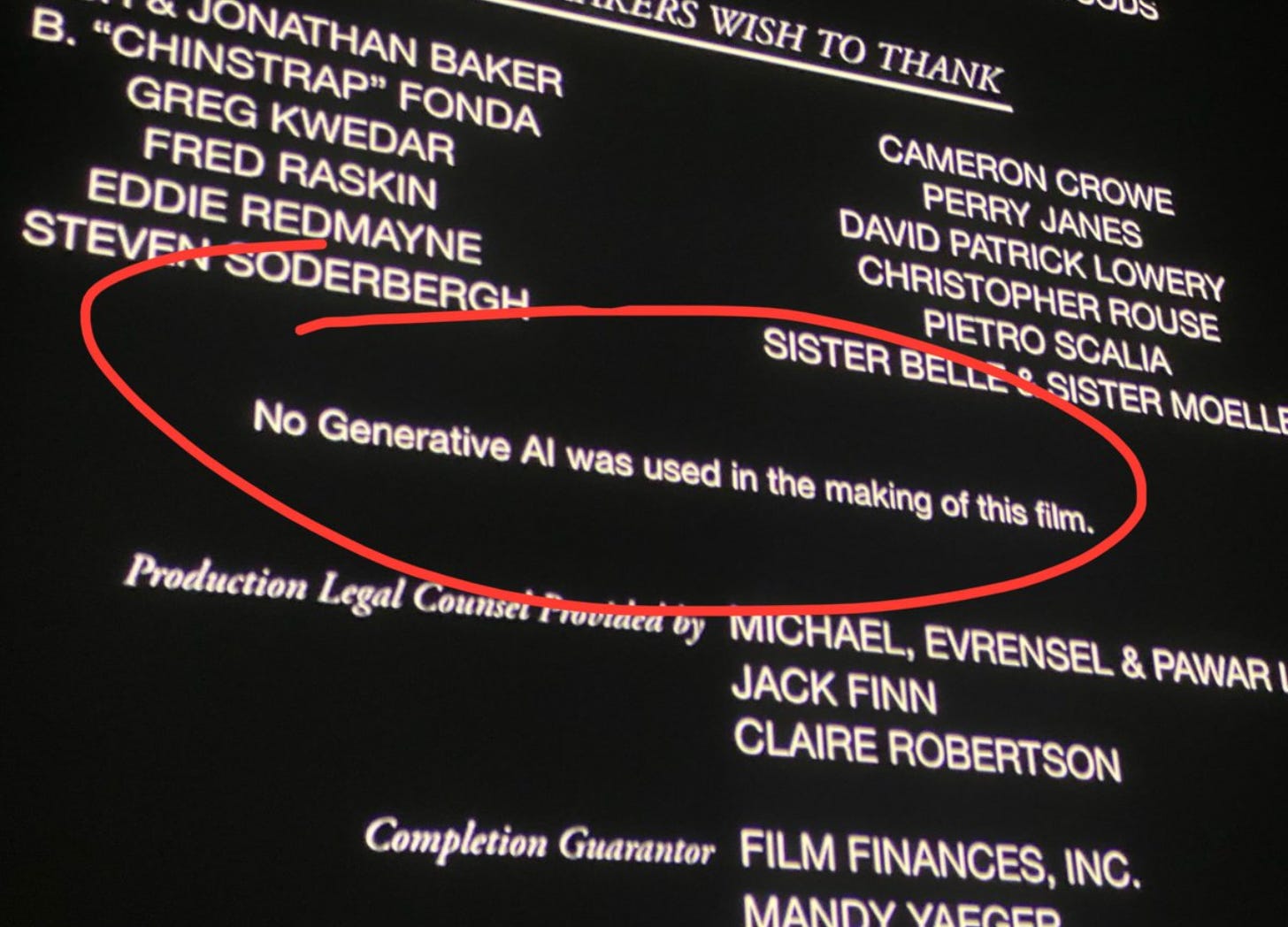
The futility of AI Labels in an AI-infused world
Let’s be honest, only a few people in the world are refusing to use ChatGPT altogether. There are people who, on ethical and environmental grounds, refuse to use ChatGPT, but even if you avoid it, when you Google anything, AI Overview is getting shoved down your throat. GenAI might be possible to dodge, but AI as a whole? Impossible. Any usage of a tech product has some degree of AI. It’s inescapable. In other words, people all over the world are using AI, including Hollywood.
Former Hollywood Reporter editor-in-chief Janice Min (now CEO of The Ankler) recently said: “The thing with AI right now in Hollywood: Everyone’s lying just a little bit. Studios are lying about how much they’re using it… I dare you to find a screenwriter who is staring at a blank page and not talking to Claude or ChatGPT at the same time.” Execs and assistants are using it appraise scripts. Producers are using it to plan. The list goes on and on.
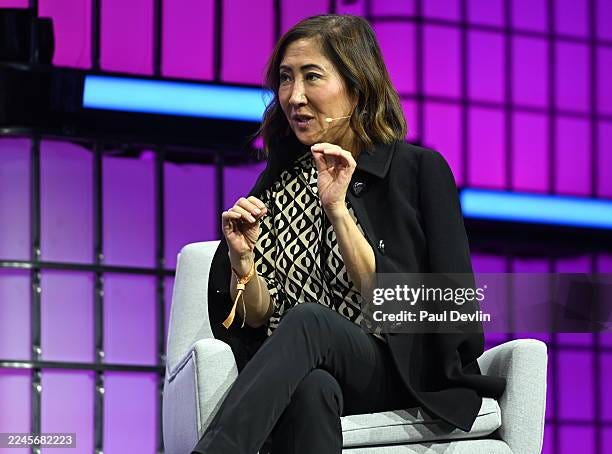
The question is how much is everyone lying in Hollywood?
And for that matter, even if they were telling the truth, do we even have an agreed upon definition of what is AI usage? Or GenAI usage? Or algorithms? Or…? It’s bewildering.
This throws a big wrench into this idea that “No AI was used in the making of...” is a useful disclosure. AI is soon going to be like the air we breathe or water we drink. (insert cough cough joke here). This is why I think these AI labels are futile.
The Anti-AI folks will not find it to be enough (as more and more people use it and understand how it works) because everyone is lying and the pro-AI folks will want their work to be taken seriously. And knowing what degree of AI was used will become noise, easier to ignore, and therefore easier to appraise what we like about a work of art irrespective of how much AI was used.
A spectrum of Zero AI to 100% AI
AI usage should be judged on a spectrum. This will help artists and audiences clarify what is palatable and demystify the work. People will be able to judge the work with more transparency. The lack of clarity and transparency, which is where we are today with agencies, studios, and artists hiding to what degree they’re using AI, is causing suspicion and feeding into narratives about why use of AI is nefarious and ethically objectionable.
This goes both ways. What the Anti-AI crowd eventually has to grapple with is the reality that everyone is using AI to some degree. And the pro-AI crowd has to cop to how much they’re using it and to what degree it has infiltrated their “sacred” creative workflows.
What I think has to happen is an over-investment in behind the scenes footage, tracking, and recording and excruciatingly clear declaration of where AI was used in the process. It will be like the new DVD bonus feature. People will need to declare what percentage of AI was used in the making of a project from pre-production/development to production, and post-production. After all, if execs and their assistants are using AI to read scripts and judge creative work and streamers are using algorithms to determine the viability of projects, shouldn’t all the cards be on the table?
Imagine a world where every exec, cast, and crew member signs off on their AI usage before release, and to what degree and which tools. Disclosure as a credit, not a disclaimer.
What this will result in is a spectrum, even down to percentage of AI used. You might even be hearing one day someone saying “oh that 80% AI-made film was awesome!” Or “god. That 20% AI-made film was sh*t! Why even use AI at all?” Or: “that 0% AI film was awesome. Love pure human magic.”
However it manifests, that clarity will breed a new way to appreciate art.
A new world of transparency aka nutrition labels
From the 1900s to the 1990s, nutritional labels went from preventative measure to a requirement. By the 2010’s amidst the wellness and longevity craze, they’re background noise behind health marketing. Protein! Amino acids! Antioxidants! Vitamins!
I would not be surprised if the level of granularity that goes into nutritional labels today is where AI labeling ends up. Teams could even clarify, in detail, what tools they used to get the job done. Eventually, it will be so obvious that AI was used that it will be a boring detail. It’s like great, you got the basic disclosures right now what did you do with it? Is it another cliche-filled Hollywood flick? Or did AI help you be original? And am I getting an interactive immersive ecosystem along with this? Or merch? Or whatever buzzword or marketing gimmick happens to be hitting that season.
The thing is nutritional labels have the FDA, to regulate and enforce. The MPAA rates films for sex and violence. The FTC polices advertising claims. But we are currently dealing with an avalanche of AI usage across multiple fields including Hollywood, gaming, XR, immersive, music, and more. There’s no singular regulatory body. There’s unions, studios, agencies, corporations, etc. How will all these organizations agree on a standard? I think it’s unlikely. It’ll likely just have to be emergent for lack of coordination.
In AI, this isn’t a new idea. Researchers at Stanford and groups working on AI provenance (Starling, the C2PA standard, the AI for Documentary coalition) have been pushing for content authenticity frameworks for years. And the Academy of Motion Pictures Arts and Sciences specified new rules on acting and writing, but not a complete ban on using AI in things like VFX, etc.:
“”In the Writing categories, the rules codify that screenplays must be human-authored to be eligible.“
“Additionally, in the Acting category, only roles credited in the film’s legal billing and demonstrably performed by humans with their consent will be considered eligible.“
For the Anti-AI folks, who think the Academy is making a blanket ban on AI, reading the fine print is a rude awakening. This is precisely the level of granularity that is inevitable and needed.
AI isn’t going away and we still don’t have the frameworks to appreciate or appraise it. We’re in a honeymoon/demonization era of it but this won’t last. Everyday we’ll get another famous person or organization embracing it and another day another famous person or organization will ban or decry it. But eventually, it’s all going to be noise and we need to get back to work, no matter much AI you use. Just tell me how much.
Work in Progress is Machine Cinema’s weekly op-ed series exploring ideas at the intersection of AI, creativity, and culture. If you’re interested in contributing, please reach out. Selected submissions will be featured and we will promote the author’s blog or work alongside the piece.
I wrote a book with AI. Start to finish: 7 weeks. Now, I just finished a story bible for a TV series with AI. Now, moving to write the story. When I was studying script writing, every instructor said: write a "good" story first! AI can write, but doesn't have intent. Writers add intent.
Agree the blanket label doesn't hold up. Specific, machine-readable disclosure works better. Google Merchant Center already asks sellers to keep the IPTC tag on AI images, and Amazon has its own tag for people generated entirely by AI. Specific beats a promise.