


Work in Progress is Machine Cinema’s weekly op-ed series exploring ideas at the intersection of AI, creativity, and culture. If you’re interested in contributing, please reach out. Selected submissions will be featured and we will promote the author’s site or work alongside the piece.
Last week, I was lucky enough to hear Ed Catmull, cofounder of Pixar and former president of The Walt Disney Company, speak at the OpenAI Forum hosted by Natalie Cone PMP and Caitlin Maltbie. Truly an amazing community and event series. I recommend everyone to join OpenAI Forum.
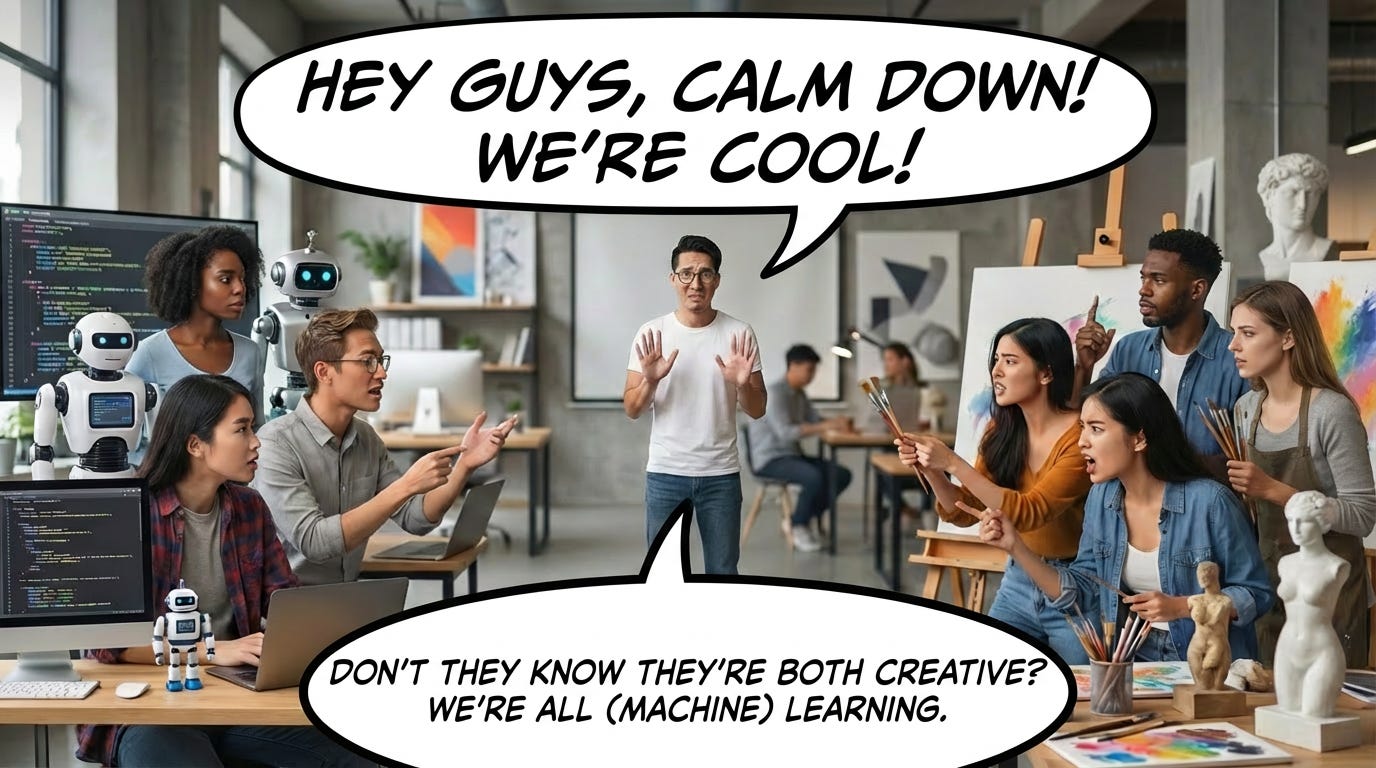
Catmull spoke thoughtfully about a dynamic he observed in the early days before and during Pixar and the world of animation and filmmaking, which was the hierarchy and dynamic between artists and technologists. Essentially, that the artists seemed to look down on the technologists and view them as second class. This dynamic permeated the industry and he felt a sense of responsibility and leadership to make sure this didn’t happen at Pixar. He worked hard to create a culture at Pixar where technologists and artists cross pollinated, saw each other as equals working together, and where both were in the act of creation and were considered creative.
This got me to thinking about the current dynamic of artists, filmmakers, and creatives versus AI and AI researchers.
The inherent problem to me is that training an AI model is abstracted very far from creation but also, it’s even abstracted away from the researchers. There’s increasing degree of granularity and directionality with AI models, but it’s a fact that for every model, researchers and practitioners alike are surprised by emergent capabilities that AI models exhibit. The result is interfaces like node-based workflows and agentic systems that squeeze the most out of unpredictably intelligent models that don’t do exactly what you want and still require a degree of creative, technical and artistic expertise. Many multi-million dollar companies are funded on this exact dilemma, we call them aggregators (Krea, Freepik, Weavy, Flora, etc.).
This is categorically different from CGI, where a growing group of open source technologists built CGI software iteratively and deliberately on top of each others scaffolding. CGI has been built brick by brick. The tools are exacting and precise. AI models are an arguably more mysterious and emergent process. I’m oversimplifying but: data + chips + energy + research + labeling = intelligence?
I see this inherent imbalance accentuated to an extreme in AI media & entertainment business. The top AI video model companies are: Google, OpenAI, Runway, Luma, Midjourney, Seedance (Bytedance), Kling (Kuaishou), Hailuo (Minimax), Alibaba Wan, LTX, Decart, etc. These are massively funded companies which can afford to put millions & billions of dollars into training better and better video models. Studios do not have that kind of capex to spare, nor business model to accommodate this. Their shareholders would think they’re insane. They can fine-tune top models, but it would take a huge amount of staff, money, compute, and data to catch up to the top 10 video models (reminder that Zuck is poaching people for hundreds of millions of dollars like basketball stars). The smaller studios and agencies are not even in this discussion at all, they barely have a million to spend on their own staff.
And then there’s the tech companies, who have to spend billions on model training and top flight researchers, and therefore cannot spare much for content, marketing, etc. The result of this is an uneasy tension and power imbalance. The tech companies must hire, contract, and work with creators to try, test, market, and teach their tools but it’s rare to find AI tool companies that have the ambition of artists, of trying to create things themselves. Let alone the budget to drop on artists to play with their tools, beyond the amount they’re giving away for free (to the tune of hundreds of millions) with hopes that they will make something great that showcases their tools.
So, back to Catmull. He worked so hard to build a company where artists and technologists thrive in a cohesive creative environment together. It’s hard for me to see how we can create a similar company today where artists and technologists are equals. The AI studios of today cannot create foundation models. The Hollywood studios can’t do it. They can ride the wave of what foundation models provide, certainly. But they’re not nearly as close to designing the actual software that does the creating. And the AI companies are rare to start their own studios with a massive commitment to storytelling and artistry.
There are examples here and there that feel like synergy. Luma AI started Dream Lab where top flight artists are leading the charge on creating new projects closely with the researchers but at the end of the day Luma is still overwhelmingly a tech company with B2B and B2C clients and the revenue goal remains one of consumer scale. There are a few companies like this. Higgsfield AI, Runway, etc. boast of a studio side, but ultimately the consumer ARR is too sexy to pass up. OpenAI, of course, dropped $30 million on a feature film called Critterz that Native Foreign is working on, but OpenAI has lots of other priorities like hardware, Sam Altman’s ambitions, and obviously maintaining the fortress that is ChatGPT. Asteria and Moonvalley and the team of Paul Trillo and Don Allen Stevenson III show impressive examples of mixing CGI, VFX, and AI to spectacular results but this feels to me like a bandaid on the current limitations in AI models. They’re hiring top flight professionals to blend all these together because all of the tools are limited. Hybrid is trendy in the ad agency and Hollywood worlds because AI just isn’t there yet. But the fact that we are even discussing hybrid is precisely further evidence that building these foundation models is so abstracted away from the artists and creatives.
In the end, I fear a Pixar of this AI era is simply not possible. The nature of the AI models is such that although any of us can vibecode an AI creative tool which taps into the APIs of the latest video models, we as individuals or even studios who’ve raised tens of millions of dollars will never be able to participate in the race for foundation models. This is for the gods of AI, the hyperscalers and venture funded behemoths.
Epilogue:
Now, of course, there’s caveats to anything in AI. The space is absolutely unpredictable. Lots of plans are secret so who knows how things will shake out. There’s also an argument to be made that the rise of vibecoding will cause more people to increasingly build their own tools as much as they are using said tools to create. A next generation auteur could be a person that can build and create at the same time. Which, btw, is a Pixarian modality. A lot of creative technologists at Pixar are storytellers and a lot of storytellers know how to code.
The future AI artist might be far away from the actual foundation model training but they could be surfing the wave anyhow and creating great work out of that. I’m struck that some of the best people I know in AI creative are vibecoding their own tools, they’re not using aggregator tools anymore, which also puts a question mark on AI aggregator companies who raised money to provide AI tools for end users. If I’m an actor-director-musician, I can vibecode the tool that compensates for things I’m not good at, like editing and sound fx. If I’m an editor-musician-sfx-writer, I can vibecode the tool that compensates for my lack of visual style, etc. If coding progress continues, anyone can create any tool for their needs.
If end users can create their own tools, does Claude Code and Codex disintegrate the line between the creator and the foundation model?
Minh Do is cofounder and CEO of Machine Cinema. With a background in venture capital, tech, media, education, theater, and film, Minh brings an opinionated eye to a space evolving at warpspeed.