


One Year Later…from 2025 to 2026
(Note: Click here you want the full PDF version of this doc.)
Let me start by saying that making any market map in the AI era is impossible. The space is moving so fast that as soon as you publish, it’s aged. This market map will probably be useless tomorrow. It’s not just speed, it’s the breadth. The space has become so vast that having a perfect 360 view is futile. But it doesn’t mean we shouldn’t try to conceptualize what’s happening.
At Machine Cinema we think it’s vitally important to track this because our goal is to aggregate this trillion-dollar creative economy as it goes through transition. When we did the first ever GenJam, our AI signature event, in 2023, the only tools at our disposal were: ChatGPT, Runway, Dalle3, and Midjourney. When I did this market map last year in Q2 2025, it was about 100 tools.
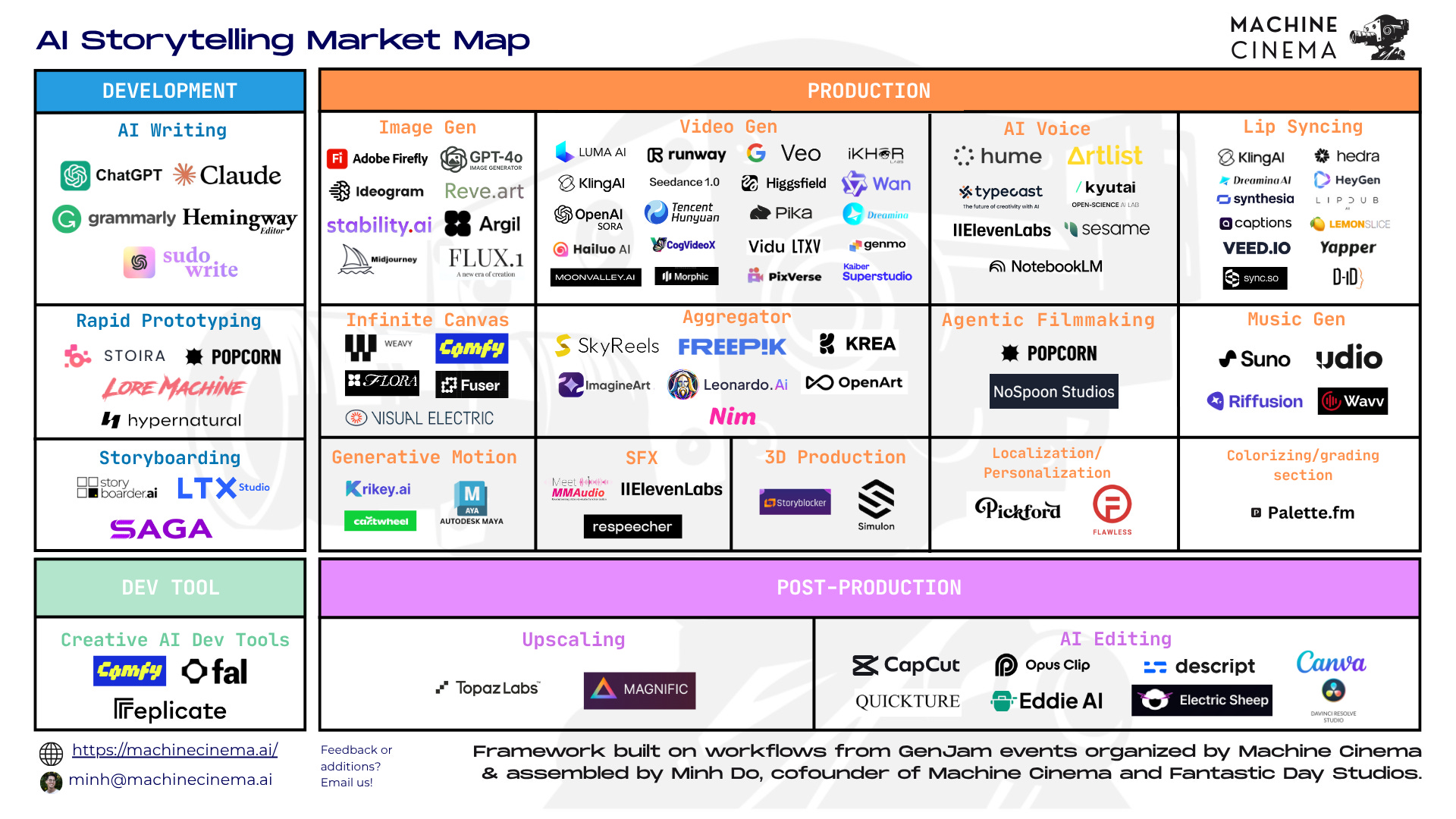
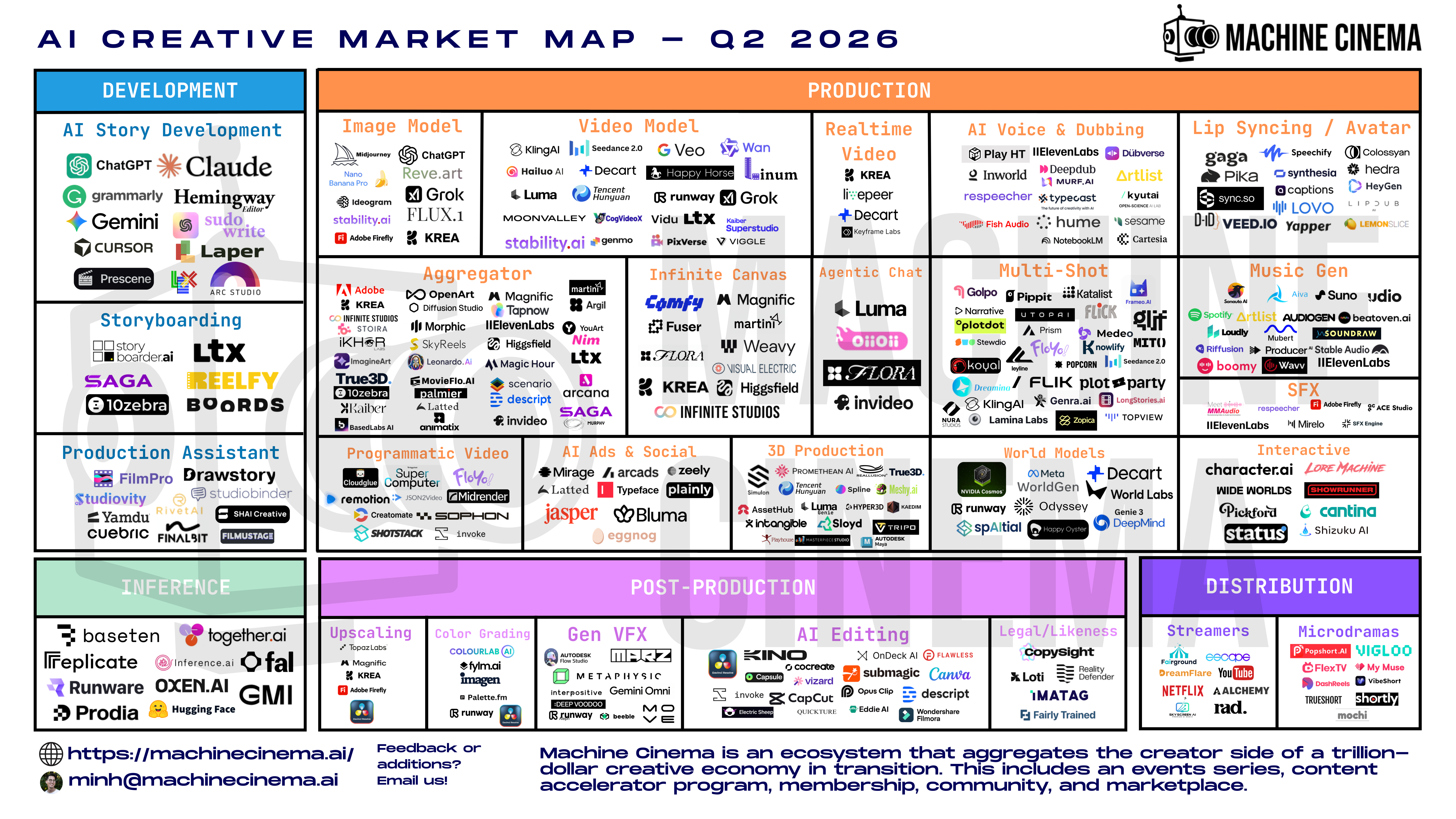
This year’s market map is over 250 tools! In 2025, I called this the “AI Storytelling Market Map” because the bulk of the conversation in early 2025 revolving around Hollywood and production. But the reality, the revenue and audience has expanded far beyond Los Angeles (arguably from day one). Elevenlabs, the leading AI voice model many AI filmmakers use for character voices, gets a majority of its revenue from enterprise accounts focused on customer service and internal comms. Midjourney, the world’s leading image model, by users, with revenue rumored to be above 10 figures, classifies a large bulk of its users as “art therapy”.
Companies have also disappeared from last year. OpenAI’s Sora2 is gone. Pika has shifted from a video model to a video agent. In the last year, many of the AI tool partners we talk to are interested in agency and enterprise sales rather than consumer.
Despite the fact that Hollywood, film festivals, and celebrities dominate the ideological airwaves on the ethics and permissibility of AI usage, the revenue and gravity of the space is elsewhere.
Things to keep in mind:
There are multiple logos in multiple places because that’s simply the nature of the space. Runway, in 2023, mainly placed all of their own models in their creative suite, but by 2026, they’re hosting Seedance and other competitors under the hood. Everyone wants to be everything. For lack of moat, become the ocean?
Although categories like aggregators and editing have grown, image and video models have remained the same. Although new entrants like Alibaba’s HappyHorse and Grok have entered the fray, building models is an expensive endeavor for hyperscalers, unicorn-sized venture-funded startups, and ad-supported entities.
Models remain the power center of the space as we saw with Seedance. To some extent, we are all downstream of model providers. When Seedance arrived onto the scene, aggregators and inference providers rushed to supply it to their users, for fear of losing them to other providers who had Seedance. As models get better they enable all the tools downstream to offer more capability to their users. Not only are the aggregators downstream of the models, but so are the AI studios and creators, although our stories, projects, and perspectives can be unique, the quality of our productions is more dependent than ever on what the models enable.
Despite models remaining stable and a proliferation of tools that offer everything under the sun, there’s been a steady rise in niches. Companies like Zeely focus solely on AI filmmaking tools for ads. Similar tools exist for AI microdramas. These tools offer the same features and models as the general tools, but targeted at their niche. The application layer remains undecided.
Given the above, it’s hard to keep track of many categories. Note that Production Assistance, AI Ads, AI Design, AI Production Studios, AI Social, 3D, Video Gaming, and Interactive could deserve their own market maps. This market map serves as a window into these rapidly growing areas.
We have deliberately omitted AI Production Studios, which although many have raised venture money on tool building, have not released these tools to the public. We have also noticed a slow down in funding for production studios despite a continued rise in venture funding for tool companies, in particular aggregators, 3D, world models, video gaming, etc..
We have seen a rise in dominance of Chinese companies coming into the space. Kling, Seedance, HappyHorse, Minimax have stayed in the top 10 for over a year. Now we’re also starting to see Chinese aggregators enter the market as well. Most of the logos on this map are from America, will this stay true by next year?
What originally started out as a space for filmmakers and designers has expanded far beyond and is not abetting.
For us, Machine Cinema has to move where the space is going. In early 2025, no one was talking about programmatic video, world models, 3D, AI video gaming, and multi-shot agents. But today, they are driving a lot of the intrigue in the space. In response, we have hosted events, workshops, and our GenJams focused on AI in immersive, games, world models, design, and more, actively experimenting with what’s coming out. Learning and creating at the same time has helped us to categorize where these tools sit within a larger creative pipeline.
Ultimately, we are driven by one central question: What does an AI creator look like tomorrow?
Enjoy the market map. We hope it serves as a guide as you plumb the depths and make your storytelling dreams come true, just don’t spend too many tokens on the way!
If you’d like to add a company, give us feedback, or just say hello, please feel free to jump over to our website: https://www.machinecinema.ai/ai-creative-market-map
Appendix
A few notes on each category.
Development / Pre-Production
Everything that happens before a frame is shot or a pixel is rendered: writing the story, planning the shots, and organizing the production.
Writing has overwhelmingly been the domain of ChatGPT, Claude, and Gemini. But more niche products like Sudo Write have arrived onto the scene, building core features around what screenwriters need. Cursor is also an unlikely entrant as a writing tool, since it’s originally for coding, but the way it handles multiple documents at once makes it a surprisingly powerful tool for character and story consistency and development.
Storyboarding has evolved considerably and frankly many of the tools that were formerly storyboarding tools have since migrated to being full-fledged aggregators simply because it has become so easy to add image and video models to any given tool.
Production Assistance is a newer category that we felt needed to be featured because we’re starting to see real competition in the space, with startups building the necessary rails to help streamline the work of producers.
Production
The stage where the work actually gets made — image, video, audio, 3D, and the interfaces that orchestrate them. This is the largest and most contested band on the map, and the one where AI’s impact is most visceral. As mentioned, image and video models remain heavily contested with a battle between mainly Chinese and American well-funded corporations. The rest of the field is a total war. Aggregators are super crowded with Infinite Canvas and Agentic Chat as rising sub-categories. Elevenlabs and Suno have retained dominance in their respective categories, but if an incumbent like Spotify enters the fray, what does that mean?
My favorite row in the production tab is the bottom 5. Programmatic Video is so exciting because it allows coders and vibe coders to tinker with bleeding edge APIs and agents to make their own tools or workflows. AI in Ads & Social should frankly be two different sub-categories but they have heavy overlaps and are still emerging. 3D Production is where I think it’s possible the best bleeding edge work for professional AI craft is. With AI tools having the reputation for being so flimsy and unpredictable, merging 3D with GenAI feels like the best of both worlds: precision and imagination. Speaking of worlds, World Models have been the hottest thing to talk about for both LLM researchers obsessed with AGI and AI filmmakers excited about the game-like potential of 3D worlds. The irony, of course, is that world models have possibly the most relevance to robotics, not the realm of creative production at all. Thus, underlining the truly sprawling nature of artificial intelligence. Interactive is my favorite space hands down. I think it’s where we most feel the inklings of AI as an entirely new medium that isn’t just skeumorphic and referring to the past. I expect that what we see in 2026 and describe as “interactive” is hardly scratching the surface of what’s to come.
It’s worth noting there’s a lot of other sub-categories I wanted to put under Production, including XR, Immersive, Events, and especially Video Games. But we chose to omit these because of space and because they either deserve their own market map with their own pointed categories or because they don’t fit under our loose definition of the production pipeline. We’re working on it.
Inference
The infrastructure layer that everything else runs on: the GPUs, model-serving platforms, and APIs that turn a creative tool’s request into an actual generation.
You probably think I’m crazy not to put companies like Nvidia and AMD here, but we had to draw the line somewhere, right? These companies, especially Fal, serve specifically inference for creative production thus making them a vital part of our ecosystem. It’s worth noting that as inference has become more competitive, widespread, and easier to apply via vibe coding, it has completely changed the landscape in production tools. Because of tools like Fal, Baseten, GMI, etc. vibe coders and coders have been able to more easily build their own aggregators, canvases and tools for production.
Indeed, some of the best creators in the Machine Cinema network build their own tools for themselves and for their clients. If I’m a writer-director-editor I have completely different feature needs and workflows from an animator-writer-actor. Maybe the Cambrian explosion has barely begun.
Post-Production
Where raw output becomes finished work: upscaling, color, visual effects, editing, and the legal scaffolding that lets it ship.
Arguably, post-production are some of the most technical tools in the business and most useful for professionals. Upscaling and color grading have been relatively quiet categories, not seeing many new entrants. Gen VFX has broadened considerably as the model companies like Google’s Gemini Omni and Runway’s Aleph are competing to allow their users to edit objects, subjects, and landscapes in any given video but also tools like Metaphysic are so niche and powerful that they’re used in major films like Here to de-age Tom Hanks.
Lastly, as AI workflows and tools have gotten more powerful, it inevitably begs the ethical and legal questions. Can I protect my likeness? Can I protect my work? We will likely see further innovation in the legal/likeness category as the tools inevitably get more powerful.
Distribution
At the end of the day, the most important problems in the space are distribution and monetization. With people spending all these tokens, how are they making money off of it? AI is expensive!
YouTube stands to win the most as the largest video player in the world, but because of Google’s policy on monetization of AI content and given the still unproven and nascent nature of the space, of course there’s space for new players. AI-specific streamers are still very new and don’t command the kind of numbers that YouTube guarantees (at a certain size) but have an opportunity to nurture the new crop of AI filmmakers whose numbers will inevitably explode. There’s also some very unique strategies of putting AI videos on televisions or even airplanes.
Microdramas, which have also captured Hollywood and dubbed “verticals”, provide both distribution and monetization rolled up in one, but the financials might not make sense yet. Microdramas are notorious for their low budgets and smut-style content which fuels addiction and subscription dollars. Will this genre evolve into more sophisticated yet equally addictive storylines? We shall see.
Conclusion #2
We hope these few notes have added color to an otherwise intimidating wall of logos. Feel free to let us know if you’d like to add any commentary, missed anything, completely disagree, or just want to show us some love. We’re open to all feedback. Thank you again for reading. Happy generating!
A
So fascinating to see this all visualized out. Thank you for doing the work of gathering all this info!